


Your knee doesn’t feel right. And you’re not sure what comes next.
Maybe you’ve been told you have a meniscus tear or irritation. Maybe you haven’t had imaging yet but something feels off — a catch, a click, a hesitation when you put weight on it. Either way, you’re probably carrying around a lot of questions.
➔ “Is this going to get worse if I keep walking on it?
➔ “Do I actually need surgery, or is there another way?
➔ “Why does my knee feel fine one day and unreliable the next?
➔ “How long am I going to be dealing with this?
These are the exact questions we hear every single day at Roscoe Physiotherapy. And they deserve real answers, not just a sheet of generic exercises and a follow-up in six weeks.
This page is here to help you understand what's actually happening in your knee, why it feels the way it does, and what a real path forward looks like. Because when you walk through our door, we want you informed, not overwhelmed, and confident that you're in the right place.
First, let’s talk about what the meniscus actually does
Your knee has two menisci, C-shaped pieces of cartilage, that sit between your thigh bone and shin bone. They’re not just passive cushions. They’re active participants in how your knee loads, rotates, and stabilizes itself with every step you take.
Shock absorption
The meniscus distributes force across the knee so no single area takes the full load during walking, squatting, or running.
Joint stability
It helps guide how the knee tracks through movement, especially during rotation and direction changes.
Lubrication
It helps spread synovial fluid across the joint, which keeps the surfaces moving smoothly and reduces friction.
When the meniscus is irritated or torn, the problem isn’t just pain in one spot. It’s that the knee starts to lose confidence in itself. Movements that were automatic start to feel uncertain, and your body notices.
Here’s something important: meniscus injuries exist on a wide spectrum. Many people with MRI-confirmed tears have no symptoms at all. Others have significant pain without a visible tear. What matters most isn’t just the image, it’s how your knee is actually functioning.
What meniscal irritation typically feels like
Meniscus-related knee pain has some pretty recognizable patterns. You might recognize yourself in several of these:
-
A catching, clicking, or brief locking sensation — like something is getting in the way
-
Pain or discomfort with deeper bending, rotation, or twisting
-
Swelling that tends to show up after activity rather than during it
-
Stiffness in the morning or after sitting for a while
-
A general feeling that your knee might “give out” or isn’t trustworthy
-
Difficulty on stairs, getting in and out of a car, or squatting low
One of the most frustrating things about this type of injury is how unpredictable it feels. Some days are fine. Other days something simple like stepping off a curb or shifting your weight sends a sharp signal. That inconsistency is exhausting, and it makes sense that it’s weighing on you.

Why the pain sticks around and why avoidance isn’t the answer
Here’s something that doesn’t get explained enough: when your knee starts feeling unreliable, your brain and body respond by protecting it. That sounds helpful, but it creates a cycle that often makes things worse over time.
1. You start moving differently
You avoid deep bends, skip pivoting, shorten your stride. These feel like smart adaptations. And early on, they are.
3. Stiffness and sensitivity increase
The less you move a joint, the less tolerant it becomes of movement. What felt manageable before starts feeling worse even with smaller provocations.
2. The muscles around the knee weaken
Because you’re loading the knee less, the muscles that support and protect it including the quads, hamstrings, and glutes start to lose their capacity. Less support means the joint has to work harder with less backup.
4. You compensate — and stress shifts elsewhere
Your hip, your other knee, your lower back pick up the slack. Now you’re managing multiple areas, not just one.
This isn’t a failure on your part. It’s a completely natural response to pain. But it’s also why waiting and hoping it resolves on its own often doesn’t work, and why getting the right guidance early makes such a meaningful difference.
"
From one of our patients, in his own words
“I had just decided not to have meniscus surgery and wasn’t sure if I was making the right decision. I had lost confidence in walking normally and felt anxious about what my future would look like. After working with the team at Roscoe for about four weeks, my strength improved, my extension improved, and I started walking normally again. I feel better about my knee — and about myself. They listened, were honest about the process, and helped me regain my confidence. I’m really glad I chose to try physical therapy first.”
— Michael Shaffer, Roscoe Physiotherapy patient
Michael’s experience is one we see often: someone who is uncertain, anxious, and not sure if they made the right call, who four weeks later has clarity, strength, and a knee they can trust again. That kind of outcome isn’t luck. It’s what happens when the right structure meets consistent effort.
How we approach meniscal irritation at Roscoe
Physical therapy isn’t one-size-fits-all, and if it has felt that way before, that’s worth acknowledging. Our approach starts with actually understanding you: your knee, your movement patterns, your goals, and what’s been getting in the way.
1. A thorough movement assessment, not just a pain check
We look at how your full body is moving, not just where your knee hurts. How your hip and ankle influence what happens at your knee. Where your body is compensating or avoiding load. What your current strength and mobility can actually support. This gives us a real picture — not just a starting point based on your diagnosis.
2. Hands-on care to reduce irritation and restore movement
Before we pile on exercises, we focus on calming down what’s reactive and improving how the knee moves. This may include dry needling, cupping therapy, joint mobilization, or targeted soft tissue work, whichever tools make the most sense for what we’re seeing. The goal is a knee that moves more freely and responds less defensively.
3. Rebuilding strength where it’s actually needed
Once your knee is less reactive, we shift to building the capacity that protects it. That means targeted quad, hamstring, hip, and glute work, and single-leg stability training that builds real-world confidence, not just gym numbers.
4. A structured return to the things you’ve been avoiding
Walking without second-guessing yourself. Stairs without bracing. Squatting comfortably. Getting back to exercise, sport, or whatever you’ve put on hold. We don’t just discharge you when the pain is gone — we make sure you’ve actually rebuilt the tolerance to do the things you care about.
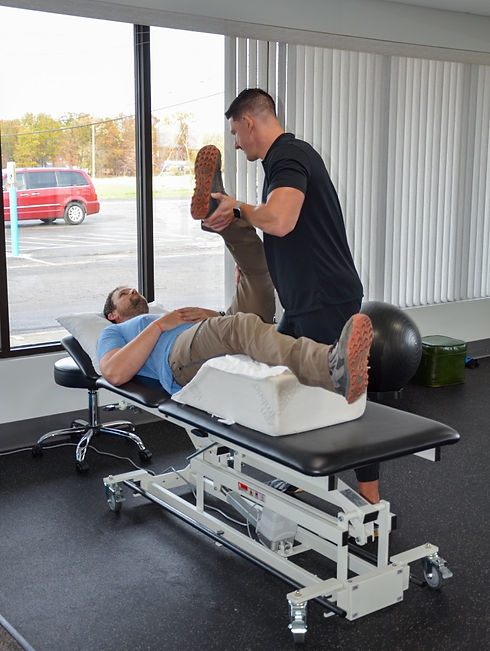
What makes Roscoe different
One-on-one, every session
You work directly with your clinician the entire time, not handed off to an aide or left on a machine. Your session is your session.
We look at the whole picture
Your knee doesn’t exist in isolation. We look at how everything above and below it is contributing, and we address those factors, not just the site of pain.
You’ll always know what’s happening and why
No mystery exercises. No vague reassurances. We explain what we’re seeing, what we’re doing, and what to expect at every step.
Your goals shape your plan
Whether you want to get back to hiking, keep up with your grandkids, or just walk without wincing, your goals are the target, not a generic recovery template.
Ready to get some clarity on your knee?
You don’t have to keep guessing. Whether you’re weighing surgery, unsure if PT is right for you, or just want to understand what’s actually going on, a knee assessment is the right first step.
We’ll walk you through what we’re seeing, what it means, and what your best next move looks like. No pressure. Just clarity.
Roscoe Physiotherapy, Hermitage, PA
CALL US
Tel: 724-982-4266
EMAIL US
HOURS
Mon - Thurs: 7AM - 7PM
Fri: 7AM - 5PM