


Maybe your knees have been stiffening up in the morning for a while now. Maybe climbing stairs has gotten harder, or you’ve started avoiding certain activities because you’re not sure how your knee will respond. And maybe someone, whether a doctor, a friend, or a Google search, has told you this is just part of getting older.
That last part isn’t the whole story.
Knee osteoarthritis is real, and it’s genuinely one of the most common sources of knee pain in adults. But “common” doesn’t mean “inevitable decline.” The research on this is clear and more encouraging than most people have been told: movement-based care is one of the most effective tools we have for managing OA pain, improving function, and helping people stay active for years longer than they thought possible.
If your knees have been quietly shrinking what your life looks like, whether that's skipping the hike, avoiding the stairs, or just bracing every time you stand up, the team at Roscoe is ready to help you change that.
What is Knee Osteoarthritis?
Osteoarthritis is often described simply as “wear and tear” on the joint. That’s not wrong, but it undersells the complexity of what’s actually happening.
Your knee joint is lined with cartilage, a smooth cushioning tissue that allows the bones to glide against each other with very little friction. Over time, through a combination of age, loading history, muscle imbalances, and genetics, that cartilage can gradually thin and break down. As it does, the joint loses some of its natural shock absorption and the surrounding structures have to work harder to compensate.
The result is a joint that’s less tolerant of stress, more prone to inflammation, and increasingly stiff after rest. That’s where the morning stiffness, the aching after a long walk, and the discomfort on stairs all come from.
One thing worth knowing: the amount of cartilage loss visible on an X-ray doesn’t always correlate with how much pain or limitation someone experiences. Two people with identical imaging can have very different day-to-day function. That matters, because it means what’s happening in your muscles, your movement patterns, and your activity levels often has as much influence on how you feel as the joint itself.
Osteoarthritis tends to develop gradually, with symptoms creeping in over months or years rather than appearing suddenly. That slow onset can make it easy to adapt around without realizing it, until one day you notice how much your daily life has quietly changed.


Common Signs of Knee Osteoarthritis
Knee OA presents in recognizable ways. You might be experiencing some of these already:
-
Stiffness in the morning or after sitting for a while that loosens up once you get moving
-
A dull ache or soreness with prolonged walking, standing, or going up and down stairs
-
Swelling around the knee, particularly after more active days
-
A grinding, clicking, or crunching sensation when the knee bends (sometimes called crepitus)
-
A reduced sense of how far you can bend or straighten the knee comfortably
-
Feeling like you need to “warm up” before your knee cooperates
-
Hesitation before activities you used to do without thinking, like a longer walk, a hike, or getting up from a low chair
It’s also worth naming what often goes unspoken: the emotional weight of this. The frustration of having a body that feels less dependable. The quiet grief of scaling back activities you love. The worry about where this is headed. These are legitimate parts of living with a chronic joint condition, and they’re something we take seriously in how we work with people.
Why Symptoms Often Worsen Over Time
Knee OA has a way of creating its own feedback loop. Here’s how it typically unfolds:
1. Pain Leads to Less Movement
When activity hurts, the natural response is to do less of it. Rest feels protective, and in the short term it is. But over weeks and months, reduced movement starts to work against you.
2. Less Movement Leads to More Stiffness
Hands-on treatment, mobility work, and strategic progression help calm irritation while improving function.
3. Muscle Weakness Increases Joint Stress
The muscles around your knee, especially the quadriceps, hamstrings, and glutes, are what absorb force before it reaches the joint. When these muscles weaken from disuse, more of every step’s impact goes directly into the already-sensitive joint. This is one of the biggest drivers of worsening OA symptoms and one of the most directly addressable.
4. Compensations Add New Problems
As the knee becomes unreliable, most people start loading the other leg more, changing how they walk, or avoiding certain movements entirely. Over time, this creates secondary pain in the hip, the other knee, or the lower back, and the original problem becomes harder to isolate and treat.
This cycle is not inevitable. It’s a pattern we understand well and know how to interrupt. The key is addressing both the joint itself and the muscular and movement system around it, which is exactly what a well-designed physiotherapy plan does.
How Roscoe Physiotherapy Approaches Knee Osteoarthritis
There’s no shortage of generic knee OA advice out there. What we do is different, and it’s different in ways that directly affect your outcomes.
You’re seen as a whole person, not a diagnosis
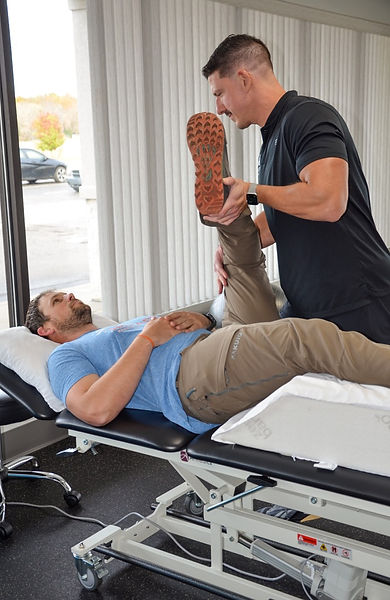
Before anything else, we spend time understanding you: your symptoms, your history, your daily life, and what you’re hoping to get back to. Then we assess how your knee is actually functioning, including how it moves, how it loads, and how the rest of your body is influencing it. That includes your hips, your ankles, and your movement patterns as a whole.
We’ve worked with patients whose knee pain was being driven primarily by hip weakness, and others whose movement patterns were placing unnecessary stress on the joint with every step. None of that shows up on an X-ray, but all of it shapes your outcomes. A thorough assessment is what allows us to build a plan that actually targets the right things.
One-on-one care, every session
Every session at Roscoe is with your clinician. Not an aide, not a rotating cast of different faces, not time on a machine by yourself. You get undivided attention, ongoing communication, and a treatment that adapts in real time as you progress.
That consistency matters more than most people realize. It’s how we catch what’s working, what needs adjusting, and when to push a little further.
Hands-on therapy to reduce pain and restore mobility
Before loading the joint with exercise, we work on improving how it moves and reducing what’s irritating it. Depending on what we find, this may include joint mobilization to restore range of motion, soft tissue work to reduce tension in the structures around the knee, or dry needling and cupping to address muscle guarding and improve tissue response. The goal is a knee that moves with less resistance and less pain, so that the strengthening work that follows can actually take hold.
Targeted strengthening of the muscles that protect the joint
This is where the long-term change happens. We build a progressive strengthening program focused on the quadriceps, hamstrings, glutes, and hip stabilizers: the muscles that absorb force and reduce stress through the knee with every step. This isn’t a generic exercise sheet. Every movement is selected and progressed based on what your assessment revealed, what your body is ready for, and what your goals require.
For many of our patients, meaningful strength gains happen faster than they expected, and with those gains comes a real, noticeable change in what their knee can handle day to day.
A home program built around your life, not a template
What happens between sessions matters as much as what happens in them. Every patient leaves with a home program specific to their assessment findings and current capacity. Not a printed sheet of standard exercises, but a focused set of movements chosen because they address what we actually found. We also work with you on how to move smarter throughout your day: how to handle flare-ups without losing ground, how to approach stairs and longer walks as your capacity builds, and how to gradually reintroduce the activities you’ve been putting off.
The goal isn’t to manage around your knee forever. It’s to give you the tools to stay active long-term.

Do I Need Surgery for Knee Osteoarthritis?
This is one of the most common questions we hear, and it deserves a direct answer.
For many people with mild to moderate knee osteoarthritis, surgery is not the first or only option. A substantial body of research shows that structured physiotherapy can produce meaningful improvements in pain, mobility, and function — often without ever needing to go under the knife.
For others, particularly those with more advanced structural deterioration or significant functional limitation, surgery may ultimately be the right path. And when it is, physiotherapy plays a critical role on both sides of that decision,helping people get as strong and functional as possible before an operation, and rebuilding strength, mobility, and confidence afterward.
What we'd say to anyone in this position: don't make that decision without a clear picture of where your knee actually stands. If you haven't yet had a thorough movement-based assessment, that's the right place to start. It's the fastest way to understand what your knee is genuinely capable of and what your most appropriate next step looks like.
What Our Patients Say
The best way to understand what care at Roscoe looks like is to hear it from the people who’ve been through it.
“I went in with knee pain and was correctly diagnosed, put on a plan that has taught me how to properly move and strengthen my knees and hips. I have found Roscoe Physio to be a wonderful, caring, and professional place.”
— DeAnn
Roscoe Physiotherapy patient
“At Christmas my knee pain flared up and I could hardly walk. With the correct exercises and stretches, I can now walk without pain. The staff truly care about you and the progress you make. They make it a fun environment. I highly recommend them!”
— Megan Pizor
Roscoe Physiotherapy patient
“Prior to going to Roscoe, all indications were that I needed some sort of surgery on one or both of my knees to alleviate the pain I was having. They determined my hips were causing my knee pain and corrected the problem without surgery. Thanks to their treatment plan and advice, I now enjoy pain-free workouts and jogging in the neighborhood.”
— Jerry Soveskyn
Roscoe Physiotherapy patient
These outcomes aren’t unusual. They’re what happens when the right assessment leads to the right plan, and when someone commits to the process.
Q: Can physical therapy actually help knee osteoarthritis, or does it just manage symptoms? A: Both, and that distinction matters less than most people think. Physiotherapy can produce real, lasting improvements in pain levels, joint mobility, and functional strength. It won’t reverse cartilage loss, but cartilage loss alone isn’t what determines how much your knee limits you. Strengthening the muscles around the joint, improving movement mechanics, and reducing inflammation can significantly change how your knee feels and what it can do, often for years. Many of our patients reach a point where their knee is no longer a daily concern.
Q: Do I need a referral to come to Roscoe Physiotherapy? A: No referral is needed. You can contact us directly to schedule your knee assessment.
Q: Is walking good or bad for knee osteoarthritis? A: Generally speaking, walking is good for knee OA. It helps maintain joint mobility, supports the muscles that protect the knee, and keeps the surrounding tissues healthy. The key is load management: walking at a volume and pace that your knee can currently tolerate, then building gradually from there. If walking is consistently causing pain that lingers for hours afterward, that’s a sign the load needs adjusting, not that you should stop. This is exactly the kind of guidance we provide as part of a treatment plan.
Q: How long does PT for knee osteoarthritis take? A: Most patients begin noticing meaningful improvement within 4 to 6 weeks. A full course of care, including building the strength and movement capacity to maintain those results independently, typically runs 8 to 12 weeks depending on severity and how consistently the home program is followed. We set clear milestones along the way so you always have a sense of where you are and what’s next.
FAQ’s About Knee Osteoarthritis and Physiotherapy
Q: What should I expect at my first visit? A: Your first session is an assessment, not a workout. Your clinician will spend time understanding your history, your symptoms, and your goals. Then they’ll evaluate how your knee moves and loads, and how your hips, ankles, and overall movement patterns are contributing. By the end of the session, you’ll have a clear picture of what’s driving your symptoms and a plan for addressing it. Most people leave that first visit feeling more informed and less anxious than when they walked in.
Q: Can PT help if my OA is severe or I’ve already had imaging showing significant cartilage loss? A: Yes, in most cases. The severity of findings on imaging is only one part of the picture. We’ve worked with patients who had significant structural changes on their scans and achieved substantial functional improvement through physiotherapy. The muscles, movement patterns, and loading strategies around the joint have a major influence on symptoms regardless of what the imaging shows. An assessment will give us a much better sense of what’s possible for your specific situation.
Ready to Find Out What’s Actually Driving Your Knee Pain?
If your knees have been slowing you down, whether for months or years, you deserve a clear picture of what’s going on and a plan built around your specific situation. Not a generic protocol. Not a wait-and-see approach. A real assessment by a clinician who will take the time to understand what’s happening and what to do about it.
Your first visit is a conversation and an evaluation. You’ll leave with answers, not just a follow-up appointment.
Schedule your knee assessment at Roscoe Physiotherapy →
Hermitage, PA | Accepting new patients