

Why Does My Knee Hurt? Common Causes of Knee Pain and What It Means
Knee Pain Is a Symptom, Not a Diagnosis
Maybe it is a sharp twinge on the third stair, every single time. Maybe it is a dull ache that shows up an hour into your workout and lingers into the next morning. Maybe it is the moment you stand up from a low chair and something clicks, catches, or just feels wrong for half a second. Different sensation, different timing, different trigger, but the question underneath all of it is the same: why does my knee hurt?
Here is the part that surprises most people. That question does not have one answer, because knee pain is not a diagnosis. It is a description. Knee pain when walking, knee pain when bending, knee pain from exercise, these tell you when something hurts. They do not tell you what is actually going wrong underneath.
That distinction is more than semantics. The same ache around the kneecap could be patellofemoral pain, an early tendon issue, or a hip that has quietly stopped doing its job. Pain location is a clue. It is not a conclusion. Treating the clue instead of the cause is exactly how people end up doing months of exercises for the wrong problem.
Your knee does not work in isolation either. It takes its cues from the hip above it and the ankle below it, and it responds to how much load you are asking it to handle relative to what it is actually prepared for right now. Two people can have the exact same pain, in the exact same spot, for two completely different reasons. Handing them the same handout would only help one of them, and only by accident.
Common Causes of Knee Pain
Most of the knee pain we see in the clinic sorts into a handful of recognizable patterns, each with its own signature. Here is what we are actually looking for when someone tells us their knee hurts.
Runner’s Knee (Patellofemoral Pain)
If your knee aches around or behind the kneecap, and it gets worse on stairs, during squats, or after sitting through a long drive with your knees bent, you are probably dealing with what is commonly called runner’s knee. Plenty of people who do not run get it too, so do not let the name talk you out of it.
The instinct is to blame the kneecap itself, but the kneecap is usually just where the problem shows up, not where it starts. It comes down to tracking, how well the kneecap glides through its groove as your knee bends and straightens. That tracking is controlled largely by hip and thigh strength. When those muscles are not doing their share, the kneecap drifts slightly off its intended path, and the tissue underneath absorbs friction it was never built to handle.
Knee Osteoarthritis
Osteoarthritis does not happen overnight. It is a gradual shift in the cartilage and joint surfaces, usually building over years, and it tends to announce itself through stiffness, especially first thing in the morning or after sitting for a while, along with an ache that flares with activity or a change in weather.
Here is the reframe that changes things for most people. An arthritis diagnosis describes what is happening inside the joint. It does not dictate how much pain you have to live with. The muscles supporting that joint have real influence over your day to day symptoms, and unlike the cartilage itself, that part is highly trainable. Arthritis is a starting point. It is not a ceiling.
Meniscus Irritation
The meniscus is the cartilage cushion that stabilizes your knee joint, and when it is irritated, it tends to announce itself with pain on twisting or deep bending, plus a catching, locking, or clicking sensation that makes the knee feel like it might give out on you, even when it does not.
That sensation alone sends a lot of people straight to thinking about surgery. It is worth knowing that not every meniscus irritation needs one. Many respond well to a program built around taking load off the meniscus while rebuilding the strength that should have been protecting it in the first place.
Patellar Tendon Irritation
Pain just below the kneecap that flares with jumping, squatting, or anything that loads the tendon repeatedly usually points to the patellar tendon, not the joint itself. It shows up most often in people who ramped up their training volume or intensity faster than the tendon could keep pace with.
Tendons actually respond well to load. What they do not respond well to is too much of it, too soon. The fix is not resting until it feels better, that tends to just delay the same problem. It is applying load in the right amount, at the right pace, so the tendon adapts instead of breaking down further.
Why Knee Pain Often Comes Back
A lot of knee pain does not stay gone. It eases up for a few weeks, maybe a few months, and then reappears the moment life gets back to normal, training ramps up again, or you finally feel confident enough to push a little harder. At that point it is easy to start believing your knee is just unreliable. It is not. What is far more likely is that the pain was calmed down without the actual problem ever getting addressed.
This is the pattern we see more than any other: pain leads to less movement, less movement leads to weakness, and that weakness quietly sets up the next flare up. Weakness that existed before the pain started rarely disappears just because the pain did. Rest quiets symptoms, but it does not rebuild capacity. A mobility restriction in the hip or ankle that never got resolved keeps overloading the knee below or above it. And the compensations you built up while protecting a sore knee, the slight limp, the altered squat, the way you started favoring one leg without noticing, do not disappear the moment the pain does either. They stick around out of habit long after they have stopped being necessary.
Then there is the final piece. The moment things finally feel better, most people return to full activity faster than the tissue underneath is actually ready for. That reopens the same door, just from a slightly different angle.
None of this means anyone did anything wrong. It means the plan addressed the pain, but never touched what was underneath it.
When Should You See a Physiotherapist for Knee Pain?
A few signs tend to mean it is time to stop waiting it out:
Pain that has stuck around for more than a few weeks despite rest
Swelling, warmth, or stiffness that keeps coming back
Trouble with basic things like stairs, kneeling, or getting up from a chair
A knee that catches, locks, or feels like it might give way
Catching yourself avoiding certain movements because you no longer trust the joint
Any one of these on its own is worth a second look. Together, they usually mean your knee has run out of ways to compensate for whatever is actually going on, and pushing through it tends to prolong the problem rather than solve it. There is also a quieter cost that is easy to miss. Once you stop trusting a joint, it changes how you move through the rest of your day, and that hesitation has a way of creating new problems somewhere else.
How Roscoe Physiotherapy Treats Knee Pain
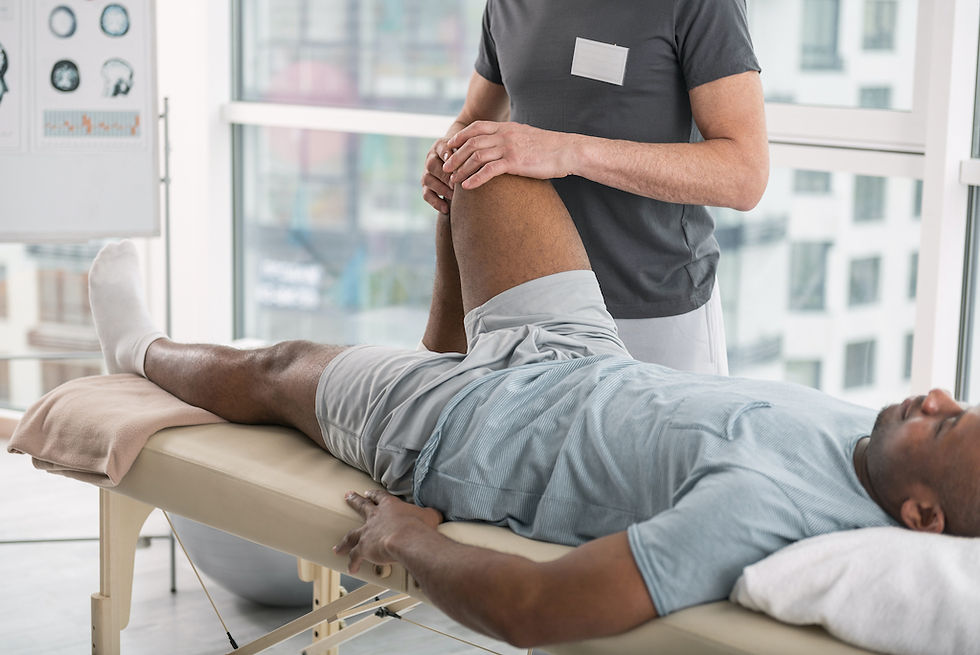
Every knee evaluation at Roscoe starts with something a lot of clinics cannot offer: one clinician, start to finish. No handoffs to an aide, no rotating cast of staff filling in the gaps. The person who assesses your knee is the same person treating it every session after, which means nothing gets lost in translation and nothing gets guessed at.
That assessment looks well past the knee itself. We are watching how your hip and ankle move, comparing strength side to side, and putting your knee through the specific movements that actually give you trouble, running, squatting, walking down a flight of stairs, whatever it is for you. The site of pain is rarely the whole story, and a real movement evaluation is what tells us where the actual story is.
From there, your plan is built to close the specific gap your assessment uncovered. That might mean rebuilding strength in the hip and thigh muscles supporting your kneecap, restoring mobility in a stiff joint above or below the knee, or gradually reintroducing movements you have been avoiding without even realizing it. Nothing about it comes from a generic handout. Every exercise you are given is there for a specific reason, and the plan changes as your knee does.
You Don’t Have to Keep Guessing About Your Knee
Knee pain rarely has one simple explanation, and guessing at the cause usually just costs you more time than you meant to spend. A real assessment can tell you, often in your very first visit, what is actually driving your symptoms and what it will take to fix it. No pressure. Just clarity.


Comments